Quick summary
A retractable arm awning with acrylic fabric and a full cassette housing is the most versatile option for most terraces in Alicante. Expect to pay between 800 € and 2,500 € installed, depending on the size and motorisation. With over 300 days of sunshine a year and some of the highest UV radiation levels in Europe, protecting your terrace is not a luxury — it is a necessity that can lower your indoor temperature by 8 °C to 12 °C.
In this guide we cover every type of awning available, compare real 2026 prices, analyse materials and give you advice tailored to Alicante’s coastal climate. If by the end you know what you need, you can request a free, no-obligation quote.
What types of terrace awnings are there?
Not all awnings are suited to every situation. Choosing the right type depends on the size of your terrace, its sun exposure, whether you need wind protection, and your budget. These are the five main types we install in Alicante (also see our awnings page for available models):
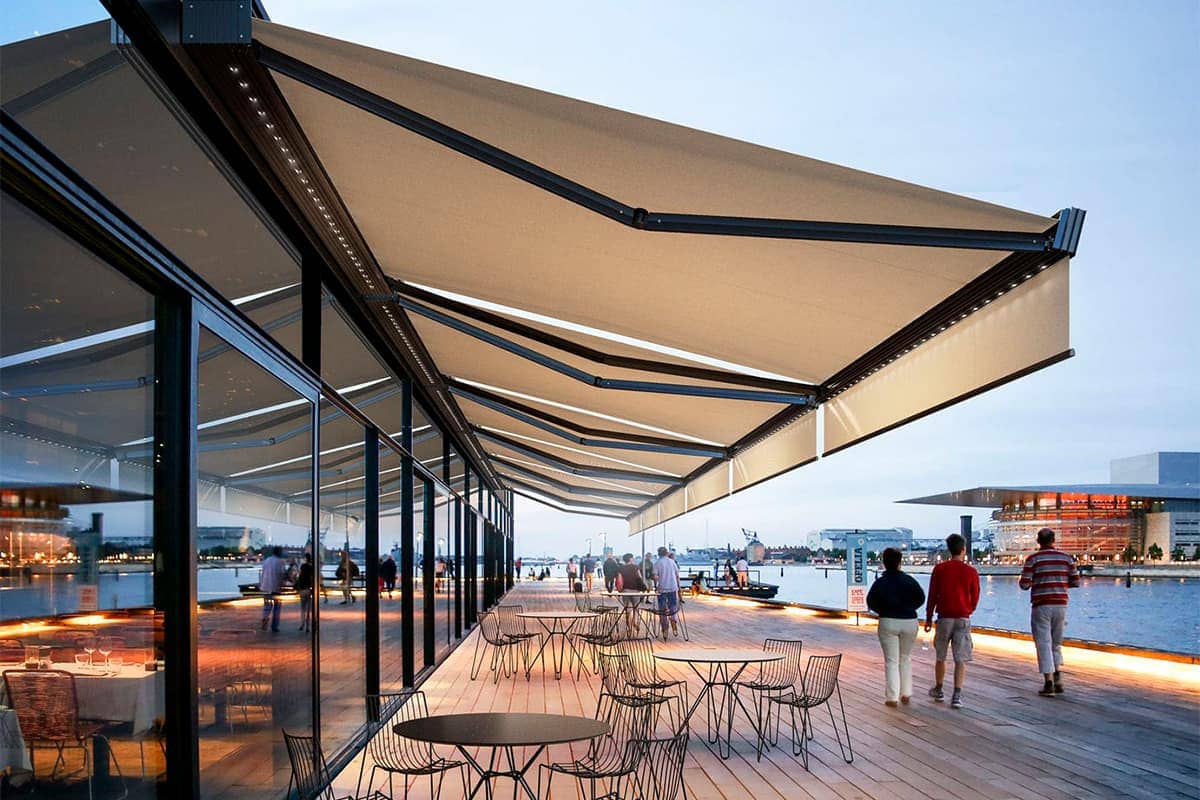
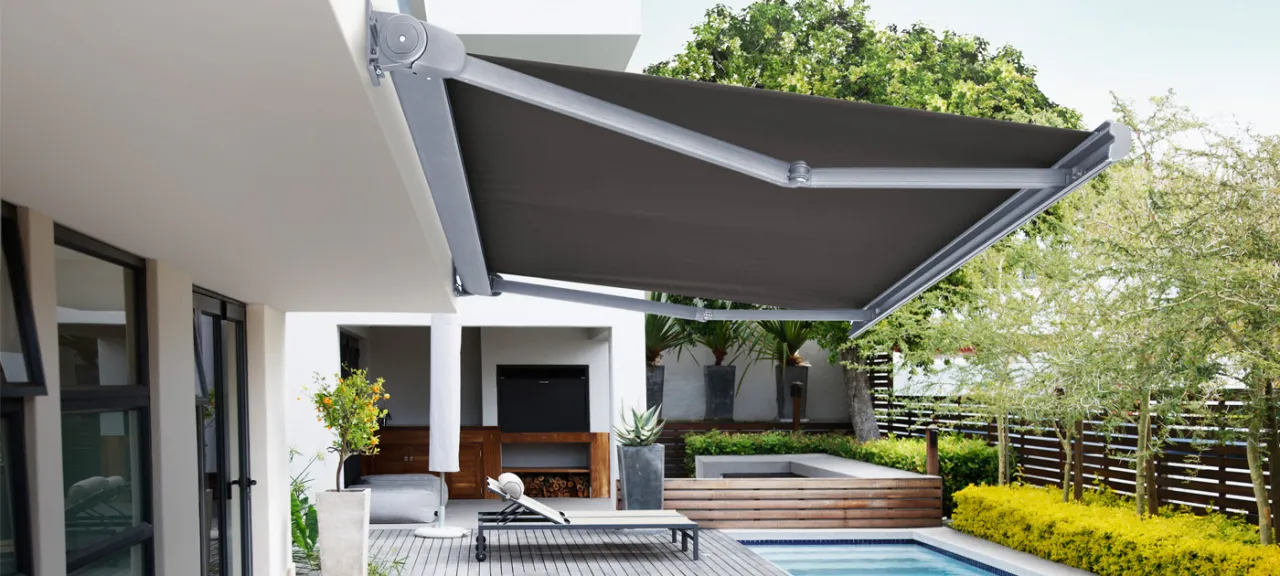
Retractable arm awning
The most popular type for residential terraces. Two articulated arms extend the fabric outward when deployed, creating wide shade without pillars or posts. Available in widths from 2 to 7 metres with projections of up to 4 metres.
Best for: large balconies, penthouse terraces, shop fronts.
Maximum projection: up to 4 metres without intermediate supports.
Drop-arm awning
Uses straight arms fixed to the wall that hold the fabric at a fixed angle, typically between 30° and 90°. They are more compact than retractable awnings and highly wind-resistant.
Best for: windows, narrow balconies, ground floors where the awning sits at pedestrian height.
Maximum projection: up to 1.80 metres.
Vertical awning (roller blind)
Works like an external roller blind. It deploys vertically and is perfect for enclosing the sides of terraces or shielding west-facing windows from the afternoon sun.
Best for: pergola sides, glazed terraces, west-facing windows.
Maximum width: up to 5 metres in a single piece.
Canopy awning (dome / basket)
Features a fixed curved structure reminiscent of classic European shopfront awnings. It adds an elegant aesthetic touch and protects from both sun and light rain.
Best for: shop windows, restaurant entrances, small balconies where design matters.
Maximum projection: up to 1.50 metres.
Window awning
The simplest and most affordable option. It installs above the window and drops down using a folding-arm system or side guides.
Best for: apartment windows, when budget is tight.
Maximum projection: up to 1 metre.
How much does an awning cost in Alicante in 2026?
Prices vary according to the type, size, fabric material, motorisation and whether it includes a cassette housing. The table below shows real market price ranges in Alicante province for 2026, with installation included:
| Awning type | Price range | Reference size | Best for |
|---|---|---|---|
| Manual retractable | 600 € – 1,200 € | 3 × 2.5 m | Balconies and medium terraces |
| Motorised retractable | 1,000 € – 2,500 € | 4 × 3 m | Large terraces, frequent use |
| Motorised retractable with cassette | 1,500 € – 3,200 € | 4 × 3 m | Maximum protection and durability |
| Drop-arm | 250 € – 600 € | 2 × 1.5 m | Windows and narrow balconies |
| Vertical (roller blind) | 300 € – 900 € | 2.5 × 2.5 m | Terrace sides |
| Canopy | 400 € – 1,000 € | 2 × 1.2 m | Shops and stylish balconies |
| Window awning | 150 € – 400 € | 1.5 × 1 m | Basic window protection |
Note: These prices include VAT and standard installation. Extra-large awnings (over 5 metres wide) may exceed these ranges. For an exact price, request your personalised quote.
What is the best awning fabric for Alicante?
Fabric choice is just as important as the type of awning. In Alicante’s climate — with extreme UV radiation (index 9–11 in summer) and coastal salt air — not just any material will do.
Acrylic fabric (the most recommended option)
- UV protection: blocks 90 % to 98 % of ultraviolet radiation.
- Breathability: allows air circulation, preventing a greenhouse effect under the awning.
- Colour fastness: solution-dyed (dyed in the mass) pigments keep their colour for 8–12 years without significant fading.
- Water resistance: repels light rain but is not 100 % waterproof.
- Anti-mould treatment: essential in humid coastal areas.
- Leading brands: Sattler, Dickson, Sauleda.
- Estimated lifespan: 10–15 years with proper maintenance.
PVC-coated polyester (waterproof)
- UV protection: blocks 100 % of radiation.
- Waterproofing: fully waterproof — withstands heavy rain.
- Breathability: none. Can cause condensation and a feeling of heat under the awning.
- Colour fastness: lower than acrylic; degrades faster under continuous sun exposure.
- Estimated lifespan: 6–10 years.
Micro-perforated fabric (screen)
- UV protection: blocks 85 % to 95 % of radiation, depending on the openness factor.
- Breathability: excellent. You can see through it.
- Waterproofing: none. Does not protect against rain.
- Main use: vertical awnings and windbreaks.
- Estimated lifespan: 10–12 years.
Our recommendation for Alicante: solution-dyed acrylic fabric with anti-mould and anti-salt treatments. It offers the best balance of sun protection, durability and thermal comfort for the Mediterranean climate.
Is it worth motorising your awning?
Absolutely. Motorisation transforms the user experience and, in many cases, extends the awning’s lifespan because it ensures correct fabric tension every time it opens and closes. Here are your options:
Basic tubular motor
- Additional cost: 200 € – 400 € on top of the manual awning price.
- Operation: controlled by a wall switch or remote control.
- Advantage: convenient, reliable, with a lifespan exceeding 15 years.
Motor with wind sensor
- Additional cost: 350 € – 600 €.
- Operation: includes an anemometer that automatically retracts the awning when wind exceeds a threshold (typically 35–45 km/h).
- Advantage: essential in Alicante, where Poniente gusts can reach 60–80 km/h without warning.
Motor with sun and wind sensors
- Additional cost: 450 € – 750 €.
- Operation: adds a light sensor that deploys the awning automatically when it detects strong sunlight.
- Advantage: maximum comfort and energy savings. The awning works on its own, optimising indoor temperature.
Smart-home integration
- Additional cost: 100 € – 300 € on top of the motor.
- Operation: compatible with systems like Somfy TaHoma, Google Home or Alexa.
- Advantage: smartphone control, scheduling and automated scenes.
Our recommendation: at a minimum, choose a motor with a wind sensor. In Alicante, an unexpected gust can destroy a retractable awning in seconds. A wind sensor is the single best investment to protect your awning.
Full cassette, semi-cassette or open? Which to choose?
The awning’s retraction system is a key factor in its durability, especially in a coastal area like Alicante.
Open awning (no cassette)
- Price: the most affordable (base option).
- Protection: the fabric and arms are exposed to the elements when retracted.
- Durability: the fabric accumulates dust, salt and moisture. Requires more frequent cleaning.
- Recommended for: installations sheltered under an existing eave or overhang.
Semi-cassette
- Price: 150 € – 300 € more than an open awning.
- Protection: covers the fabric from above but leaves the arms partially exposed.
- Durability: a good compromise between price and protection.
- Recommended for: partially sheltered terraces.
Full cassette
- Price: 300 € – 600 € more than an open awning.
- Protection: the fabric, roller tube and arms are completely sealed inside an aluminium housing.
- Durability: the best. Protects against rain, dust, salt, bird droppings and insects.
- Recommended for: any installation directly exposed to the elements, especially near the seafront.
Our recommendation for Alicante: full cassette, whenever budget allows. Coastal salt air and Saharan dust clouds (calima — common in spring and summer) are the biggest threats to awning fabrics and mechanisms. A cassette can double the lifespan of the fabric.
How does Alicante’s climate affect your awning?
Alicante has a dry Mediterranean climate with very specific characteristics you should be aware of:
Extreme UV radiation
With over 3,000 hours of sunshine a year and a UV index reaching 10–11 in July and August, materials degrade from sun exposure far faster than in northern Spain. Only solution-dyed acrylic fabrics withstand this exposure without losing colour or mechanical properties within a decade.
Wind
- Sea breeze: common on summer afternoons (15–25 km/h). Generally not a problem.
- Poniente: a hot inland wind that can reach 50–80 km/h. It is the leading cause of awning damage in the province.
- Levante: a moist easterly wind that brings rain. Less frequent but more persistent.
Tip: a wind sensor with a 35 km/h threshold is a must for any retractable awning without lateral protection.
Salt air and coastal humidity
Within 2 km of the coast, salt corrodes fixings, oxidises mechanisms and damages fabrics without specific treatments. Always insist on AISI 316 stainless-steel fixings and anti-corrosion-treated mechanisms.
Saharan dust (calima)
Alicante experiences calima episodes — fine Saharan dust suspended in the air — several times a year. This dust sticks to the fabric and can leave permanent stains if not cleaned promptly. A full cassette protects the fabric from calima when the awning is retracted.
How to keep your awning in good condition
Basic regular maintenance can double the lifespan of your awning. Follow these guidelines:
Monthly cleaning (5 minutes)
- Fully extend the awning.
- Brush it gently with a soft brush to remove dust and leaves.
- If there are calima stains, rinse with low-pressure water (never use a high-pressure washer).
Deep clean every six months (30 minutes)
- Prepare a solution of warm water with mild, pH-neutral soap (never bleach or harsh detergents).
- Apply with a soft brush over the fabric.
- Rinse thoroughly with clean water.
- Let it dry completely before retracting. Never retract the awning while it is still wet.
Annual mechanism check
- Check the arm tension.
- Verify the motor is working correctly.
- Inspect fixings and wall anchors.
- Lubricate arm joints with silicone spray.
After calima or heavy rain
- Extend and clean as soon as possible to prevent dust from becoming embedded.
- After heavy rain, let the awning dry before retracting.
How to choose the perfect awning: decision guide
Answer these questions to determine the type of awning you need:
1. How much space do you want to cover?
- Under 2 m projection: drop-arm or window awning.
- 2 to 4 m projection: retractable arm awning.
- Over 4 m projection: consider a bioclimatic pergola or combining a retractable awning with vertical windbreaks.
2. Which direction does your terrace face?
- South or south-west: maximum sun exposure. You need an awning with high UV protection and, most likely, lateral windbreaks.
- East: morning sun. A standard retractable awning is usually enough.
- West: afternoon sun — the most uncomfortable. Combine a retractable awning with a vertical awning on the side.
- North: little direct sunlight. You may not need an awning at all, or a drop-arm may suffice.
3. Are you within 500 m of the seafront?
- Yes: full cassette is a must, AISI 316 stainless-steel fixings, motor with wind sensor.
- No: a semi-cassette may be enough, but a full cassette is still recommended.
4. What is your budget?
- Under 500 €: manual drop-arm awning with acrylic fabric.
- 500 € – 1,500 €: manual or basic motorised retractable awning.
- 1,500 € – 3,000 €: motorised retractable with cassette and wind sensor.
- Over 3,000 €: large-format awnings or combined solutions.
5. Do you need rain protection?
- Occasional use in light rain: acrylic fabric with a minimum 15° tilt drains water effectively.
- Full rain protection: consider a bioclimatic pergola or complementary glass curtains. If you are torn between a pergola and an awning, read our bioclimatic pergola vs awning comparison.
Next step: request your quote
Now that you know the types, materials, prices and the specifics of Alicante’s climate, you are in a position to make an informed decision. At Optim Toldos we work exclusively with top-quality materials adapted to the Mediterranean climate and offer professional installation with a guarantee.
Request your free, no-obligation quote — we visit your home, take measurements and present a detailed proposal within 48 hours.