Switching to PVC windows with double glazing can cut your heating and cooling bills by 30 % to 40 % in Alicante. In real numbers, an average 90 m² home with old aluminium windows lacking a thermal break spends between 1,200 and 1,800 euros a year on air conditioning and heating. With quality PVC windows, that figure drops to 750–1,100 euros — a saving of 450 to 700 euros every year. Given that Alicante’s climate is extreme in summer (temperatures above 35 degrees for 4–5 months) yet mild in winter, the investment pays for itself in 6 to 9 years.
In this guide we look at exactly how PVC windows work, compare them with the alternatives, calculate the real return on investment and review the grants available so you can make the best decision.
How do PVC windows insulate?
The secret behind PVC as a window material lies in its extremely low thermal conductivity. While aluminium conducts heat at 160 W/mK (watts per metre-kelvin), PVC has a conductivity of just 0.16 W/mK. That means aluminium transfers heat 1,000 times faster than PVC.
Multi-chamber profiles
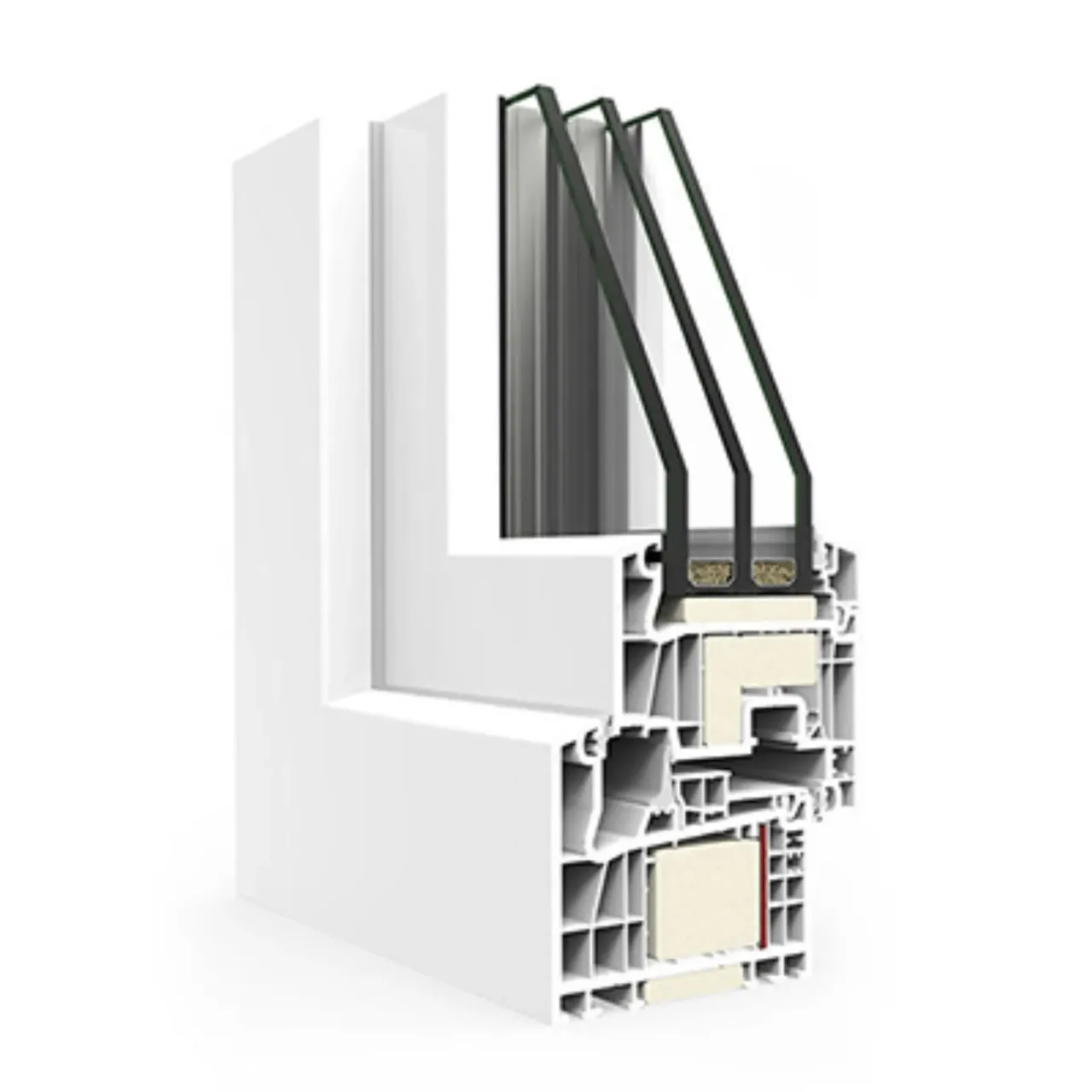
Modern PVC profiles are not solid — they contain between 3 and 7 internal air chambers that act as additional insulating barriers. Each chamber traps a layer of still air that slows heat transfer.
- 3 chambers: Basic level. Frame thermal transmittance (Uf) of approximately 1.3 W/m²K. Suitable for mild climates.
- 5 chambers: Standard level. Uf of 1.1 W/m²K. Recommended for Alicante.
- 6–7 chambers: Premium level. Uf of 0.95 W/m²K. Maximum insulation, ideal for high-efficiency homes.
Double and triple glazing
The glass accounts for 70 % to 80 % of the window’s surface area, making it the single most important factor in insulation:
| Glazing type | Transmittance (Ug) | Solar heat reduction | Guide price per m² |
|---|---|---|---|
| Single glass (4 mm) | 5.7 W/m²K | 10 % | 25–35 euros |
| Double (4/16/4 with air) | 2.7 W/m²K | 25 % | 55–75 euros |
| Double with argon gas (4/16/4) | 1.1 W/m²K | 30 % | 70–90 euros |
| Double low-emissivity + argon | 1.0 W/m²K | 45 % | 85–110 euros |
| Triple with argon + low-E | 0.6 W/m²K | 55 % | 130–170 euros |
For Alicante, the best value-for-money combination is double glazing with low-emissivity glass and an argon gas chamber. Triple glazing delivers superior performance, but its 40–60 % premium takes longer to pay back in our relatively mild winters.
How does PVC compare with aluminium?
This is the question we are asked most often. Here is a detailed comparison:
| Feature | Old aluminium (no thermal break) | Aluminium with thermal break | 5-chamber PVC |
|---|---|---|---|
| Frame transmittance (Uf) | 5.7 W/m²K | 2.5–3.2 W/m²K | 1.1–1.3 W/m²K |
| Sound insulation | 25–28 dB | 32–37 dB | 38–47 dB |
| Corrosion resistance | Low (oxidises in salt air) | Medium (better treatment) | Excellent (immune) |
| Maintenance | Medium (repaint every 8–10 years) | Low | Minimal (wipe with water) |
| Lifespan | 20–25 years | 30–35 years | 40–50 years |
| Interior condensation | Very common | Occasional | Rare |
| Recyclable | Yes (100 %) | Yes (100 %) | Yes (up to 7 times) |
| Standard window price (120 × 120 cm) | 180–250 euros | 350–500 euros | 300–450 euros |
| Colour options | Unlimited (powder-coated) | Unlimited (powder-coated) | Wide range (foil-wrapped) |
In Alicante, the corrosion resistance of PVC is especially relevant. Salt-laden coastal air deteriorates untreated aluminium within a few years, causing white spots and stiff mechanisms. PVC is completely immune to salinity, making it the ideal material for homes within 5 kilometres of the coast.
How much can I actually save in my Alicante home?
Let’s work through a real-world calculation. We take a typical home in Alicante as a reference:
Starting data
- Floor area: 90 m² (3-bedroom flat)
- Glazed area: 12 m² (6 average-sized windows)
- Main orientation: South-southeast (the most common in Alicante)
- Current windows: Aluminium without thermal break, single or old double glazing
- Climate zone: B4 under Spain’s Technical Building Code
Energy consumption before the change
| Item | Period | Estimated consumption | Annual cost |
|---|---|---|---|
| Air conditioning | May–October (6 months) | 2,400 kWh | 840 euros |
| Heating | December–February (3 months) | 1,200 kWh | 420 euros |
| Total heating/cooling | 3,600 kWh | 1,260 euros |
Energy consumption after switching to PVC
With 5-chamber PVC windows and low-emissivity double glazing with argon:
| Item | Estimated reduction | New consumption | New cost |
|---|---|---|---|
| Air conditioning | -35 % | 1,560 kWh | 546 euros |
| Heating | -40 % | 720 kWh | 252 euros |
| Total heating/cooling | -37 % | 2,280 kWh | 798 euros |
Estimated annual saving: 462 euros (and up to 700 euros in homes with more glazing or less favourable orientation).
Return on investment (ROI) analysis
| Item | Amount |
|---|---|
| Cost of 6 PVC windows (supply and installation) | 3,200–4,500 euros |
| Average annual saving | 462 euros |
| Payback period | 6.9–9.7 years |
| Cumulative savings over 20 years | 9,240 euros |
| Increase in property value | 5 %–8 % (3,500–8,000 euros for an average flat) |
If you add in the increase in property value (PVC windows improve your energy performance certificate, which translates into a higher sale price), the investment is clearly worthwhile. If you also have a terrace, you can further improve insulation by enclosing it with glass curtains.
Why is PVC especially beneficial in Alicante’s climate?
Alicante has a dry Mediterranean climate with very specific characteristics that make PVC the ideal choice:
Long, intense summers
With average temperatures of 30–32 degrees from June to September and peaks above 38 degrees in July and August, insulation against heat is the priority. PVC windows reduce solar heat gain by 35–45 % compared to aluminium without a thermal break, keeping interiors 5 to 8 degrees cooler without needing air conditioning.
Over 300 days of sunshine a year
Alicante receives between 2,800 and 3,000 hours of sunshine annually. This constant radiation subjects windows to daily thermal stress. PVC withstands expansion-contraction cycles without warping, whereas aluminium can develop gaps in its seals over the years.
Mild but humid winters
Alicante winters rarely drop below 5 degrees, but relative humidity can reach 80–85 % on December and January nights. Aluminium windows without a thermal break cause condensation on the inner glass, which leads to mould and health issues. PVC, because it does not transmit the cold from outside, virtually eliminates this problem.
Coastal salt air
As mentioned earlier, the salt-laden sea breeze is aluminium’s natural enemy. PVC does not corrode, flake or change colour when exposed to salinity. For homes near the coast, this advantage is decisive.
Coastal wind
Alicante experiences wind gusts of up to 70–80 km/h during Levante storms. PVC windows with a double or triple perimeter seal system offer class 4 air permeability (the highest under the UNE-EN 12207 standard), which prevents the draughts that are common with old windows.
What types of glass are most suitable for Alicante?
The glass is just as important as the profile. These are the most relevant options for our climate:
Low-emissivity glass (Low-E)
Features a microscopic layer of metal oxides that reflects infrared heat. In winter it retains indoor warmth; in summer it rejects part of the outdoor heat. This is the recommended standard option.
Solar-control glass
Has an additional coating that reduces solar energy transmission by up to 60 %. Ideal for south- and west-facing windows in Alicante, where direct radiation is intense for 8–10 hours a day in summer.
Argon gas chamber
Argon is a noble gas 34 % denser than air, which reduces convection inside the chamber. It improves insulation by 15–20 % compared to a standard dry-air chamber, at an additional cost of just 15–25 euros per square metre.
Solar factor: the key in Alicante
The solar factor (g-value) indicates what percentage of solar energy passes through the glass. For Alicante we recommend:
- North-facing: g = 0.50–0.65 (more light, less need for blocking)
- East/west-facing: g = 0.35–0.50
- South-facing: g = 0.25–0.40 (maximum solar control)
What acoustic benefits do PVC windows offer?
Beyond energy savings, PVC windows deliver far superior sound insulation:
- Aluminium without thermal break, single glazing: 22–25 dB reduction
- PVC with standard double glazing: 35–38 dB reduction
- PVC with acoustic double glazing (PVB interlayer): 42–47 dB reduction
To put these numbers in context, a street with moderate traffic generates 65 to 75 dB. With acoustic PVC windows, that noise drops to 25–30 dB indoors — equivalent to a library.
This is especially relevant in areas of Alicante such as the city centre, the Benalua district, the San Blas neighbourhood or near Avenida de Denia, where traffic and nightlife produce high noise levels.
What grants and subsidies are available?
There are currently several funding programmes for window replacement in the Valencia region:
Building Energy Rehabilitation Programme (PREE)
- Amount: Up to 40 % of the cost (60 % for economically vulnerable households)
- Maximum: 3,000 euros per dwelling for glazing improvements
- Requirement: Improve the energy rating by at least one grade
- Deadline: Annual calls — check the IVACE website for current rounds
Income tax deductions
- National deduction: 20 % of amounts invested in energy efficiency improvements (maximum base of 5,000 euros), provided the heating/cooling demand improves by at least 7 %
- Regional deduction (Valencia region): Up to an additional 150 euros per taxpayer for home-improvement investments
Reduced VAT
Renovation and energy-improvement works on homes over 2 years old qualify for 10 % VAT instead of the standard 21 %, as long as the cost of materials does not exceed 40 % of the total invoice.
Green finance
Many financial institutions offer green loans with favourable terms (APR of 3–5 %, no arrangement fee) for certified energy-efficiency projects. This is a worthwhile option if you prefer not to pay the full amount upfront.
How to choose the right PVC window
To make the best choice for your Alicante home, consider these factors:
- Profile with at least 5 chambers and a Uf below 1.3 W/m²K
- Double glazing with low-E glass and argon as a minimum
- Quality hardware (from a reputable brand such as Roto, Siegenia or Winkhaus)
- Opening system suited to the space: tilt-and-turn for bedrooms, lift-and-slide for terraces (if you are looking to enclose a terrace, also consider glass curtains)
- Profile colour that harmonises with the facade: woodgrain foil is the most popular choice in Alicante
- Integrated roller shutter with an insulated box if you also need to replace the shutter
At Optim Toldos we work with the leading European PVC profile manufacturers and advise you on the optimal configuration for your home based on orientation, location and budget.
Summary: the key figures
| Metric | Value |
|---|---|
| Average heating/cooling saving | 30–40 % |
| Annual saving in euros (90 m² flat) | 450–700 euros |
| Payback period | 6–10 years |
| PVC window lifespan | 40–50 years |
| Sound insulation | Up to 47 dB reduction |
| Maintenance required | Clean with water and mild soap |
| Grants available | Up to 40 % of cost |
If you want to know exactly how much you could save in your home, request a no-obligation quote. We carry out a free site visit to measure up, assess the orientation and the needs of each room, and propose the most efficient solution for your specific case.