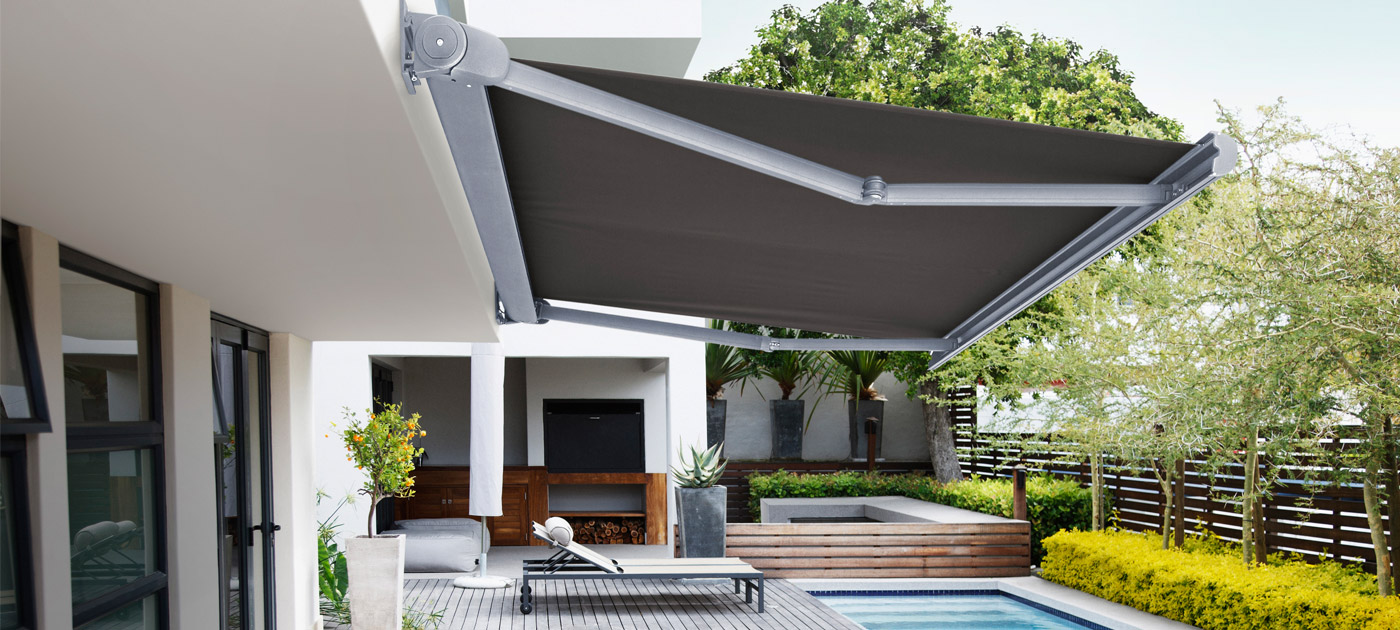
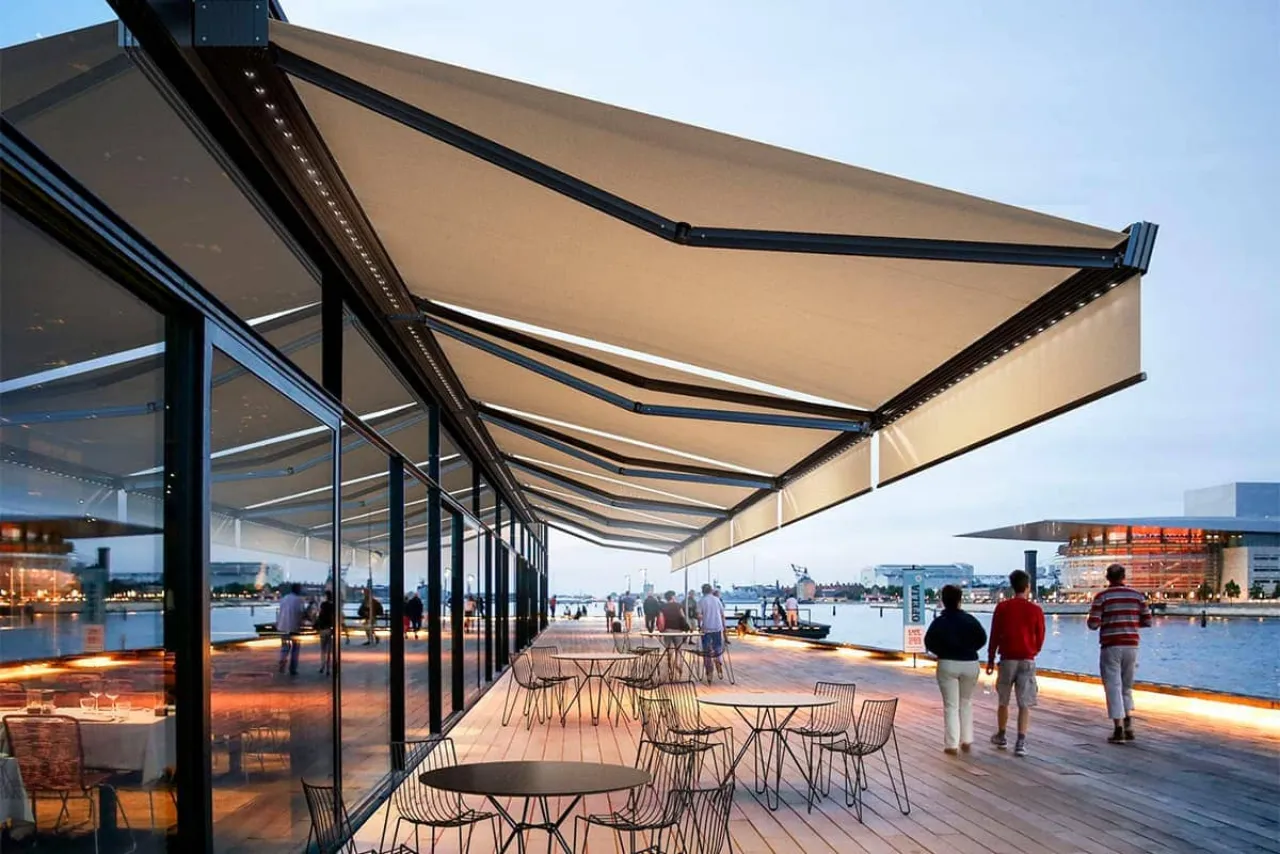
Neither the bioclimatic pergola nor the awning is universally better — the right choice depends on your budget, how you use your terrace and the level of protection you need. A quality retractable awning costs between 1,000 € and 3,000 € installed and is the quickest, most affordable way to create shade (see our complete guide to awnings in Alicante for more detail). A bioclimatic pergola starts at 4,500 € and can exceed 15,000 €, but it provides total protection against rain, wind and sun, with a lifespan two to three times that of an awning.
In Alicante, with over 300 days of sunshine and a climate that invites outdoor living from March through November, this decision can be the difference between a terrace you only use in summer and an outdoor space that is liveable almost all year round. Below, we compare both solutions point by point so you can choose based on the facts.
What are the key differences?
This table summarises the main differences between bioclimatic pergolas and retractable awnings:
| Feature | Bioclimatic pergola | Retractable awning |
|---|---|---|
| Installed price (4 × 3 m) | 4,500 € – 12,000 € | 1,000 € – 3,000 € |
| Lifespan | 25 – 40 years | 10 – 15 years |
| Sun protection | Total (adjustable louvres 0°–135°) | High (90–98 % UV with acrylic fabric) |
| Rain protection | Total (closed louvres channel water away) | Partial (light rain only) |
| Wind resistance | Up to 120 km/h (fixed structure) | Up to 35–50 km/h (must be retracted) |
| Installation time | 1 – 3 days | 2 – 4 hours |
| Construction work required | Ground or wall anchors (possible minor civil work) | Facade fixings (drill holes) |
| Light regulation | Infinite (adjustable louvres) | All or nothing (open or closed) |
| Ventilation | Excellent (louvres allow airflow) | Good (breathable fabric) |
| Added property value | High (+5 % to +10 % of the terrace’s value) | Moderate (+2 % to +4 %) |
| Annual maintenance | Low (cleaning and greasing) | Medium (cleaning, arm inspection) |
| Aesthetics | Modern, architectural | Functional, wide colour range |
How much does each option cost?
Bioclimatic pergola prices in 2026
The price of a bioclimatic pergola depends on its size, finish, motorisation and extras (LED lighting, lateral windbreaks, heaters).
| Size | Mid-range | High-end |
|---|---|---|
| 3 × 3 m (9 m²) | 4,500 € – 6,500 € | 7,000 € – 10,000 € |
| 4 × 3 m (12 m²) | 5,500 € – 8,000 € | 8,500 € – 13,000 € |
| 5 × 4 m (20 m²) | 8,000 € – 12,000 € | 12,000 € – 18,000 € |
| 6 × 4 m (24 m²) | 10,000 € – 15,000 € | 15,000 € – 22,000 € |
Included: aluminium structure, motorised adjustable louvres, remote control, installation.
Typically not included: integrated LED lighting (+300 € – 800 €), lateral windbreaks (+500 € – 1,500 € per side), concealed water drainage, civil work if required.
Retractable awning prices in 2026
| Size | Manual | Motorised | Motorised with cassette |
|---|---|---|---|
| 3 × 2 m | 500 € – 800 € | 800 € – 1,200 € | 1,100 € – 1,600 € |
| 4 × 3 m | 700 € – 1,100 € | 1,100 € – 1,800 € | 1,500 € – 2,500 € |
| 5 × 3.5 m | 1,000 € – 1,500 € | 1,500 € – 2,300 € | 2,000 € – 3,200 € |
| 6 × 3.5 m | 1,300 € – 1,800 € | 1,800 € – 2,800 € | 2,500 € – 3,800 € |
Included: structure, acrylic fabric, installation. Motorised versions include motor and remote.
Comparing a 4 × 3 m bioclimatic pergola (roughly 7,000 € on average) with a motorised retractable awning with cassette of the same size (roughly 2,000 €), the pergola costs 3.5 times more. However, if you consider that the pergola lasts 30 years versus 12 for the awning, the annualised cost is very similar: 233 € per year for the pergola vs. 167 € per year for the awning.
How long do they last? Durability and lifespan
Bioclimatic pergola
- Aluminium structure: does not rust, warp or need painting. With the right powder coating (marine treatment for coastal areas), the structure can last over 40 years.
- Aluminium louvres: the most exposed component. The louvre seals degrade over time and may need replacing every 10–15 years (cost: 200 € – 500 €).
- Motor: 15–20-year lifespan. A replacement motor costs 300 € – 600 €.
- Estimated total lifespan: 25 – 40 years.
Retractable awning
- Acrylic fabric: 8 to 12 years in Alicante, depending on orientation and maintenance. The intense coastal UV radiation shortens the lifespan compared to inland areas. Replacing the fabric costs 200 € – 600 € depending on size.
- Arms and mechanism: 15–20 years if kept greased and protected in a cassette.
- Motor: 15–20 years.
- Estimated total lifespan: 10 – 15 years before needing full replacement or re-covering.
Durability verdict
The pergola wins convincingly. Its aluminium structure is virtually indestructible. In Alicante’s climate, with coastal salt and Saharan dust, an awning without a cassette may need re-covering in as little as 6–8 years, while a pergola will look as good as new.
Which protects better against Alicante’s climate?
Sun protection
- Pergola: adjustable louvres let you control the amount of light precisely. At 90° they block the sun completely; at 45° they filter light to create a pleasant ambience; at 0° (open) they let all the light through. It is like having a dimmer switch for the sun.
- Awning: works on an all-or-nothing basis. When deployed, it blocks 90 % to 98 % of UV radiation with acrylic fabric. When retracted, it offers no protection.
Winner: the pergola, for its infinitely adjustable shading.
Rain protection
- Pergola: with the louvres closed and proper water channelling, a bioclimatic pergola turns your terrace into a covered space that drains water through its pillars. You can sit outside during a downpour without getting wet.
- Awning: handles light rain if it has some tilt, but water can pool and form pockets that damage the fabric and structure. It is not designed as rain protection.
Winner: the pergola, hands down.
Wind resistance
- Pergola: a fixed structure anchored with heavy-duty fixings. Good-quality pergolas withstand winds of up to 120 km/h with the louvres open. Even during a severe Poniente episode (60–80 km/h), the pergola does not budge.
- Awning: must be retracted in winds above 35–50 km/h. A wind sensor is essential in Alicante. If not retracted in time, the arms can bend or the fabric can tear.
Winner: the pergola, especially on the Alicante coast.
Salt-air resistance
- Pergola: powder-coated aluminium with marine treatment handles the salt-laden environment without issue. It does not rust or deteriorate.
- Awning: the fabric needs a specific anti-salt treatment. The fixings and arms, if not made from AISI 316 stainless steel, corrode within 3–5 years near the coast.
Winner: the pergola.
How does each option affect your property value?
A terrace covered with a well-integrated bioclimatic pergola can increase the perceived value of a property by 5 % to 10 %, according to property valuers in the Alicante area. It is a structural improvement that buyers appreciate.
An awning, being removable and shorter-lived, has a smaller impact on valuation: 2 % to 4 %. That said, a terrace with no sun protection in Alicante is a negative that buyers notice immediately.
What does each installation involve?
Bioclimatic pergola installation
- Time: 1 to 3 days, depending on size and complexity.
- Construction work: may require ground anchors (micro-piles or footings), drainage channels and, in some cases, structural reinforcement. This means minor civil works.
- Permits: a building permit is generally not required for demountable structures, but it is worth checking with the local authority and, in apartment complexes, obtaining community approval.
- Access: you need space to handle the components (beams can be 4–6 metres long).
Retractable awning installation
- Time: 2 to 4 hours.
- Construction work: drill holes in the facade for the brackets. No civil work required.
- Permits: generally not needed for a private home. In apartment complexes there may be restrictions on colour or model.
- Access: much simpler. Can be installed from the terrace itself or using a ladder.
How much does each system cost to maintain?
| Maintenance task | Bioclimatic pergola | Retractable awning |
|---|---|---|
| Clean louvres / fabric (monthly) | 10 min with a hose | 10 min with a soft brush |
| Deep clean (every 6 months) | 30 min, water and mild soap | 30 min, water and mild soap |
| Grease mechanisms (annually) | 15 min, silicone spray | 15 min, silicone spray on arms |
| Professional service | Every 3–5 years (~100 €) | Every 2–3 years (~80 €) |
| Wear-part replacement | Louvre seals every 10–15 years (~300 €) | Re-covering every 8–12 years (~400 €) |
| Estimated annual maintenance cost | 30 € – 50 € | 40 € – 70 € |
The pergola requires less maintenance in the long run because its structure is more robust and has no textile components that degrade under UV radiation.
When should you choose a bioclimatic pergola?
Choose a bioclimatic pergola if:
- Your budget exceeds 4,500 € and you are looking for a long-term solution.
- You want to use the terrace year-round, even in rain or wind.
- Your terrace is large (over 12 m²) and needs structural protection.
- You value adjustable light and ventilation at different times of day.
- You are on the seafront and need maximum wind and salt resistance.
- You want to increase your property value with a permanent improvement.
- You plan to add lighting, heating or windbreaks to create an outdoor living room.
When should you choose an awning?
Choose a retractable awning if:
- Your budget is limited (under 3,000 €) and you need sun protection now.
- Your terrace is a balcony or small space where a pergola is not feasible.
- You only need shade in summer, not rain or wind protection.
- You live in an apartment where installing a pergola would require complicated permits or is structurally unfeasible.
- Your homeowners’ community imposes restrictions that rule out fixed structures.
- You want a quick solution: from the site visit to installation can take less than 2 weeks.
Can you combine a pergola and an awning?
Yes — and it is a very effective combination. In fact, it is one of the most popular solutions in Alicante for large terraces. The most common setups are:
Pergola + lateral vertical awnings
The pergola covers the top while vertical awnings (screen or roller-blind type) close off the sides to protect against low sun (morning and evening) and side wind. It is a more affordable alternative to glass curtains for enclosing the sides.
Pergola + retractable awning for extended shade
If your terrace is longer than the pergola, a retractable awning can cover the extra area affordably. This is common on terraces deeper than 6 metres.
Retractable awning + vertical windbreak
For those who cannot install a pergola, combining a retractable awning for overhead shade with a vertical awning on the west side (afternoon sun) is the best solution within a tight budget.
Our recommendation for Alicante
If your terrace is larger than 12 m² and your budget allows, a bioclimatic pergola is the smartest long-term investment. In a climate where you can enjoy the outdoors more than 280 days a year, turning your terrace into a fully habitable space with total protection is well worth the investment.
If budget is the limiting factor or your space does not allow a fixed structure, a motorised retractable awning with cassette and wind sensor is an excellent solution that will serve you well for over a decade with proper maintenance.
Either way, the key is choosing materials suited to Alicante’s coastal climate: powder-coated aluminium with marine treatment, solution-dyed acrylic fabric, stainless-steel fixings and motors with wind sensors.
Need help deciding?
At Optim Toldos we install both bioclimatic pergolas and retractable awnings from leading brands. We visit your terrace, assess the conditions (orientation, wind, salt air) and recommend the solution that best fits your needs and budget.
Request your free, no-obligation quote — we respond within 24 hours.